Sunday, September 27, 2009

Burundi Refugee Farmers


What do you do as a refugee in America with few career skills? The Seattle-area Burundians, including Adirine Ntirabampa, turned to the land. She and others pick bean leaves, which some African cultures consider a delicacy.


Ranito Simbagoye weeds the corn crop in late summer. With many hands pitching in for the good of the community, corn will soon be ready for harvest.


Workers often spend their days in stooped labor at the Hope Burundian Community Cooperative farm in Kent. At night, some go to dish washing jobs or take classes in English as a second language. Others, unable to speak English, haven't found paying jobs.


Celestine Sibomana, farm manager, works with potatoes at the Hope Burundian Community Cooperative Farm in Kent. The land has not been certified organic, but the workers are using organic methods.


Njambi Gishuru, a Kenyan immigrant, helped the Burundians adjust and resettle here. "I can't begin to tell you where we started," she said. "There was a lot of fear, hopelessness."


All day trucks rumble past the Burundians' farm, a plot of agricultural land in a sea of warehouses in the Kent Valley. Celestine Sibomana, farm manager, works in the field.


Members of the Hope Burundian Community Cooperative harvest potatoes in Kent.


Farming on the urban fringe may seem odd. But any further away, and the Burundians would have a lot more trouble getting there. Farm manager Celestine Sibomana travels every day by bike. Others come by bus or walk. Only a few members of the community own cars.


Hakizimana listens to farm manager Celestine Sibomana (at center) during a community meeting, held every three months. The refugees work together to solve group problems. If someone can't make rent, others will chip in to help.


(from left) Serges Hakizimana(cq), 29, shakes hands with Barutanzaro Ntahondi(cq), 70, after a Burundian community meeting at a Tukwila apartment. Serges lead a ceremony that honored farm workers with gifts for their hard work and dedication. Most of the workers received soap, while one man received a bike.


The Seattle-area Burundians view themselves as a family, making plans and trying to solve problems together. Speciose Barera braids the hair of Phoebe Niyongabire, 4, during a community meeting this summer.


(From left) Jenifer Niyishobora talks with Grace Nyabenda, vice president of Hope Burundian Community Cooperative. Nyabenda is also the leader for the women in Burundian community.


Grace Nyabenda, vice president of the Hope Burundian Community Cooperative, listens during the community meeting while holding her daughter Josephine Nishobora, 3.


At a recent community meeting, children quietly played while the adults discussed business. Here, Odax Manirakiza takes a break to cuddle with his daughter Mary Manirakiza, 4.


The Burundian community meeting closes with a prayer.


With temperatures topping 100 degrees in August, the Burundians struggled to keep the crops alive, spending hours watering their acreage by hand.


Beans, planted scattershot instead of in rows, were somewhat of an experiment. Adirine Ntirabampa collects the leaves, which will mostly be used for family consumption.


During the heat wave, it looked for awhile like the crops might not make it. Earlier this summer, Domisio Baragenya waters by hand.


Members of the Burundian "Hosanna" Choir, including Diana Ndayahundina (second from left) and Violet Mfisumukiza (third from left), sing during their weekly practice at the Angle Lake Neighborhood Church. The group performs for some Sunday services.


Serges Hakizimana, leader of the Hope Burundian Community Cooperative, leads a meeting after the choir practice. Hakizimana said he would like to become a spiritual leader sometime in the future.


The Seattle-area Burundians are Pentecostal Christians who worship at the Angle Lake Neighborhood Church in SeaTac. Clockwise from right, Violet Mfisumukiza, Diana Ndayahundina and Serges Hakizimana pray for Roger Kabura, bottom right.


Violet Mfisumukiza carries her baby while practicing dance steps and songs with the Burundian "Hosanna" choir.


Mary Manirakiza, 4, carries her doll like Burundian mothers, wrapped on her back.


Finally, it's harvest time. Hakizimana digs up one of the farm's first potatoes, in mid-September. But with a potential for thousands of pounds of produce, they still have no way to haul it to the farmers markets.


With experience as an agriculture supervisor, Celestine Sibomana was chosen to oversee the farm.


(From left) Adirine Ntirabampa and Speciose Barera pick some of the beans at the farm in Kent.


After helping to set up the produce stand, Odax Manirakiza rests. Manirakiza works at the farm and at a West Seattle Goodwill.


Under the shade tree they jokingly call "the office," Roger Kabura cleans off his feet after a day's work. Their aim is to be self-sufficient next year.

To read Maureen's written story about the Burundian farmers: http://tiny.cc/Nma9z

Monday, September 7, 2009

North Cascades National Park


Sitka Valerian blooms in heather meadows on the trail to Cascade Pass in North Cascades National Park.


Tree canopy opens up midway on the trail to Cascade Pass.


Bronze bells, on trail to Cascade Pass


Footbridge in lush lowlands, at the start of the to Easy Pass


Columbine, on route to Cascade Pass.


Easy Pass, North Cascades National Park.
(The name of this hike is misleading. Strenuous Pass or Kick Your Ass Pass would be a much more appropriate title.)


Devil’s club leaf grows in the lowland forests on the trail to Cascade Pass


Talus Fields, like this one near Easy Pass, provides habitat for pikas.


Cascade Pass summit, North Cascades National Park

Monday, August 24, 2009

Ravenna Kibbutz


Clustered around Seattle's North End synagogues, there are three intentional living communities for young Jewish adults.

The Ravenna Kibbutz started in 2007, inspired by other local cohousing arrangements as much as the socialist Israeli collective farms of old, the kibbutz has rapidly become a magnet for Jewish young adults moving to Seattle.

The houses are located just a few doors down from one another. The residents host weekly meals, as well as coffeehouse nights where friends play instruments. Rent is inexpensive so residents are able to focus on volunteering or other civic work.

It's about building community. It's about sharing their lives, and faith.

From left, Dane Kuttler, Larissa Brown and Kelly Hanna carry plates and bowls between the Ravenna Kibbutz houses preparing for the potluck Shabbat dinner held every week.

To read the article in The Seattle Times: http://tiny.cc/jEQ4j

Friday, August 21, 2009

Vava and the Japanese Antique Sale


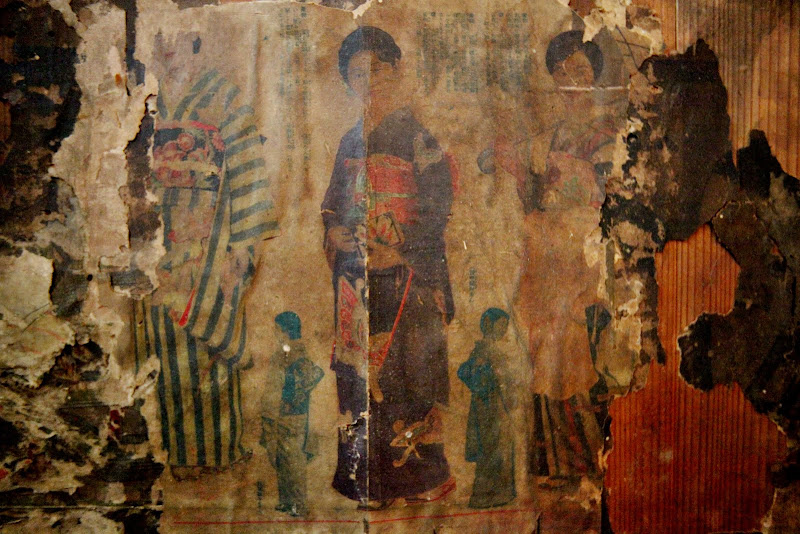
Earlier this week, Vava (my almost in high-school, diva-amiga) and I visited the Georgetown neighborhood in South Seattle. Every couple of months, we get together to catch up and explore Seattle with our cameras. After hitting a record shop/comic shop, we peeked into the old Rainier Brewery, now a labyrinth of weird working spaces and artist lofts. Inside one dark space, two men were unloading crates of Japanese antiques for an upcoming sale. Above, are a couple of photographs of tattered newspapers that were fixed on to the back of an old store counter top. A photo of Vava, and her fabulous wild hair, is in the middle.

Monday, August 17, 2009

Holga Dog Surf


Awhile back, my boyfriend and I celebrated our two-year anniversary with a trip to the Oregon Coast. During our travels, we surfed for a day an Indian Beach at Ecola State Park. There, we met a wave warrior and his dog. The pup was pretty skilled, and likely stayed on the board longer than either of us. Above, are a few Holga frames of inspiration.


A big mamma tree, photographed through a lens baby.


Families exploring Seaside, Oregon.


Manuel number one, with a lens baby.


Manuel number two, with a lens baby. Isn't it fun to use his wonderful Christmas present?


Forest in Ecola State Park, with lens baby.


Ecola State Park viewpoint, looking north towards Indian Beach.


Purple wildflowers in Ecola State Park.

Monday, August 10, 2009

Perils and Pleasures of NW Picnicing


From left: Melissa Geiss, 18, Theresa Hoey, 17, Anthony Galvan, 17, and friends roast marshmallows at Golden Gardens Park. With vistas of the Olympic Mountains and Puget Sound, the beach's fire pits are a popular hangout throughout the summer well into the Pacific Northwest's colder months.


Golden Gardens group, more likely focused on drink than food.


The Climbers Picnic includes the elements of picnics across America: meat cooked on an open grill.


Kate Berreth and Evan Anderson, right, cuddle near the grill in a shelter at Seattle's Golden Gardens Park with friends Allison Van Horn and Zach Davidson. The friends say they picnic often, but especially when it's nice out.


Allison Van Horn, 22, prepares her toast for a hot dog while grilling with friends at Golden Gardens.


Kate Berreth savors that picnic classic, fresh watermelon, on a cool May day.


Amelie Millard, 4, plays among the petals in the park next to the Columbia City Farmers Market in the Rainier Valley. Her family and friends join many others who picnic and play there in all kinds of weather.


Brooke Gerber-Perham, 6, and her father, Bruce Perham, snack on ice cream at the Columbia City Farmers Market, where the neighborhood festivities extend into the adjacent park.


Father Satish Devani, son Aakash Devani, mother Aarti Devani, grandmother Lilawati Kothawade and daughter Ketaki Devani picnic at Seward Park along Lake Washington. The family, originally from India, say they used to travel 50 miles outside of Mumbai to find an uncrowded place to picnic. Satish surprised his wife with the picnic after Aarti told him she wanted a day to feel close to nature.


Dan McComb and Lara Feltin picnic on the banks of Lake Washington at Seward Park, less than 50 feet from where they were married 4 and a half years ago.

To read Karen Gaudette's story, on picnicking culture in the Northwest visit:
http://seattletimes.nwsource.com/html/pacificnw/2009407608_pacificpicnic05.html
All images copyright Erika Schultz or The Seattle Times